What Do ID and OD Mean and Why Does it Matter?
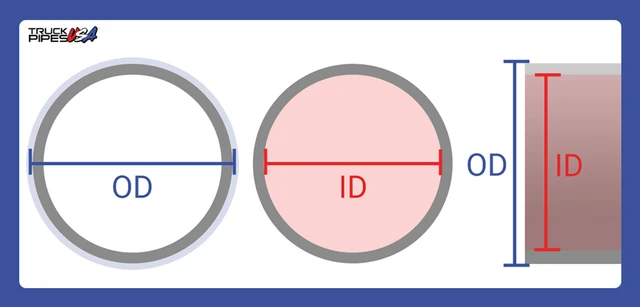
When buying or replacing your truck exhaust pipes, there are two key measurements to keep in mind: inside diameter, or ID, and outside diameter, or OD. ID measures the inner cavity and is used to calculate the capacity and flow of pipes. OD measures the widest outside edge and is important for properly fitting components.
At Truck Pipes USA, we want to provide our customers with the information they need to select the right exhaust parts. Read on to learn why ID and OD are so important to know, how to differentiate the inlet and outlet of an exhaust component, and how to get the accurate measurements you need.
What's the Difference Between ID and OD?
These two measurements are easy to confuse if you don't understand what they are. Mixing up the two could result in exhaust parts that don't quite fit. That, in turn, could lead to increased back pressure in the system and reduced engine efficiency.
Inside Diameter
The inside diameter measures the space in the pipe available for liquid or gas to flow. You can directly measure the ID with a tape measure or a set of calipers.
Alternatively, you can calculate its value using the following equation:
ID = OD - (2 × wall thickness)
The inside diameter is:
- Important for calculating velocity, flow rate, or pressure drop
- Used for determining the capacity of a pipe
- The standard measurement for exhaust tips and mufflers
In general, if you're concerned with what the pipe is carrying rather than where it goes, you want the inside diameter.
Outside Diameter
The outside diameter is the distance across the whole pipe. You can measure it from outer pipe wall to outer pipe wall with a tape measure or a set of calipers.
Outside diameter is used for:
- Fitting an exhaust pipe or other pipes and sleeves
- Determining compatibility with existing components
If what matters is the size of the pipe itself, such as when you're installing or replacing an exhaust pipe, you want to know the outside diameter.
Measuring Your Pipes
While most truck pipes list their measurements in the component specs, it's still a good idea to measure your pipes before purchasing a new component. Corrosion, wear, and production tolerances can all change the exact width of a pipe, and mismatched measurements could reduce horsepower and engine efficiency.
How To Identify the Inlet and Outlet
Exhaust flows in one direction through a system. So most components have an inlet where gases enter and an outlet where they leave. To measure your pipes correctly, you need to know which is which.
Some exhaust components have an arrow stamped on them to indicate the direction of exhaust gas flow. Other components have wider inlets and narrower outlets.
You can also look for the wear patterns on your components. Inlets are hit with intense heat from incoming gases, so they tend to show more heat damage than outlets. Outlets often look a little cleaner or have their own wear patterns.
If you're unable to remove a part from your exhaust system to see these signs, try to trace the flow of exhaust from your engine through your exhaust system. Check your truck's service manual for help.
How To Measure a Pipe
After you've identified the inlet and outlet, the next step is to grab a rag or paper towel along with a measuring instrument. A tape measure works, or you can use digital calipers for greater precision. Then follow these steps:
- Using your rag or paper towel, clean both the inlet and outlet. A dirty or grimy surface can affect your measurements.
- If you're using calipers, place the jaws inside the pipe to measure the ID, or outside the pipe to measure the OD.
- If you're using a tape measure, measure from inside wall to inside wall for the ID, or across the whole width of the pipe for the OD. You can also obtain the OD by measuring the circumference of the pipe all the way around and dividing by 3.14.
- Double-check your numbers. Try to take the measurements from several different angles, especially if the pipe is dented.
Compare your numbers with the specs listed in your service manual. If there's a big discrepancy, you may want to double-check your measurements.
The Importance of Knowing ID vs OD
So, which dimension is more important, inner or outer? That depends on what you're doing.
Proper Fitting
If you're installing or replacing pipes, you want to know the OD. Knowing this measurement helps ensure that the pipe is the right size to pass through holes, fit into clamps, or connect to fittings.
Components such as exhaust tips and mufflers fit inside exhaust pipes, so you often need the ID when purchasing those parts.
Flow Capacity
Flow capacity is a function of a pipe's internal diameter. If you are trying to figure out how much fluid is passing through a pipe or how fast the fluid is moving, you want the internal diameter.
Structural Integrity
Structural integrity, pressure resistance, and load-bearing capacity are all determined by the thickness of the pipe. Rather than directly measuring pipe thickness, it can be easier to calculate this by subtracting the OD from the ID and dividing by two.
Component Compatibility
Mistaking OD for ID could have serious consequences. It could result in system failures or major leaks. You may not even be able to assemble components.
Be sure to measure both ends of the pipe, as the inlet and outlet sizes may be different.
Find Your Ideal Pipes at Truck Pipes USA
If you're purchasing exhaust components or trying to figure out pipe capacity, you need to know the applicable OD and ID. Fortunately, those measurements are easy to get with a few simple tools.
At Truck Pipes USA, we're committed to helping our customers find the top-quality OEM and aftermarket exhaust parts they need. We offer a wide selection of parts, including many that are niche or hard to find. All of our parts are top quality and adhere to IATF 16949:2016 standards.
Shop our online catalog today, or contact our U.S.-based customer service team if you have any questions about using OD and ID to fit your exhaust pipes.